"AI app builder" means something new in 2026. A wave of tools — Lovable, Replit, Base44, Bolt — now generate a working app from a text prompt, writing the code for you. They're genuinely impressive. So it's a fair question: with all that AI, is Softr still the best way to build an app?
I build on Softr for a living, so weigh my bias. But I've used the AI builders too, and the honest answer isn't "Softr wins everything." It's that Softr and the AI code generators are solving different problems — and for the kind of app most businesses actually need, that difference decides it.
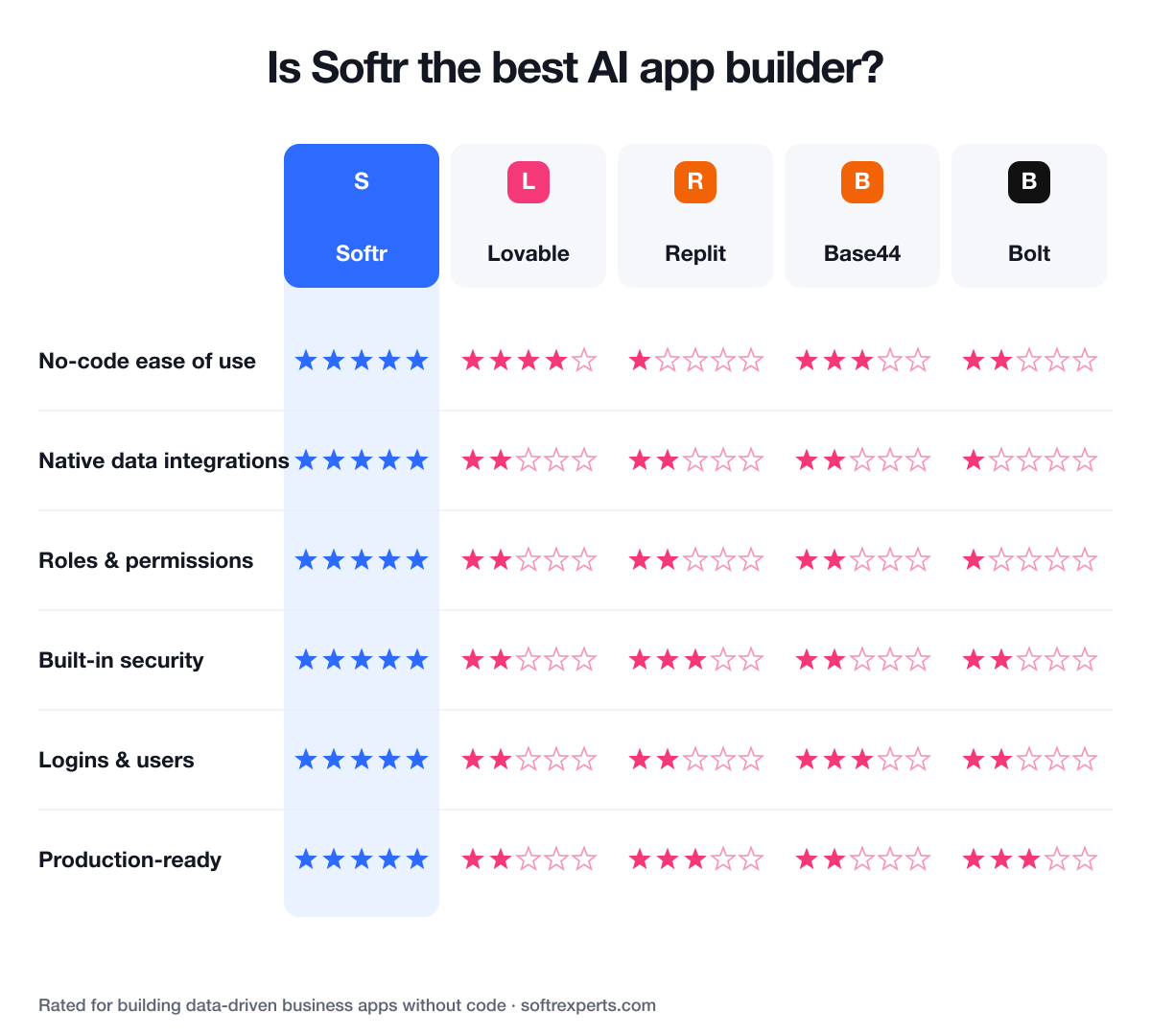
Two different kinds of "AI app builder"
There are really two categories hiding under the same label:
- AI code generators — Lovable, Bolt, Replit, Base44. You describe an app, the AI writes the code. Brilliant for spinning up a custom prototype or a bespoke interface fast.
- Structured no-code platforms — Softr. You connect your data (Airtable, a database) and assemble a real app from proven building blocks, with AI assisting along the way.
The first writes you code. The second gives you a product — with the boring-but-critical parts (logins, permissions, security, hosting) already solved and battle-tested. That distinction is the whole story.
Where Softr wins: data-driven business apps
For the apps most businesses need — client portals, internal tools, directories, membership sites — Softr leads on the things that actually matter, and it's not particularly close.
- Native data integrations. Softr sits directly on Airtable, Google Sheets or a database. Your team manages data in a tool they know; your app stays in sync automatically. AI code generators start from a blank database you have to design, build and wire up yourself.
- Roles & permissions. Row-level access — "this client sees only their records" — is built into Softr and genuinely robust. In a code-generated app, permissions are code you now own, test and secure. This is the single most common thing that goes wrong in a DIY build.
- Built-in security & logins. Authentication, memberships and user management come solved and maintained in Softr. In a generated app, they're your responsibility from day one.
- Production-ready, not just a demo. AI generators are dazzling at the first 80% — a working prototype in minutes. The last 20% (edge cases, security, reliability, keeping it running) is where generated apps stall and where Softr's managed platform quietly carries you.
- No-code ease. You can maintain and extend a Softr app yourself for years. A generated codebase eventually needs a developer — the AI got you the first version, but someone has to own the code after that.
Where the AI builders genuinely win
To keep this honest — and honesty is the point — the AI code generators are the better choice for real cases:
- Bespoke, novel interfaces that don't fit a no-code block library.
- Rapid throwaway prototypes to test an idea this afternoon.
- Full custom logic where you (or a developer) want complete control of the code.
If your app is genuinely one-of-a-kind and you have the engineering to own what the AI produces, a tool like Lovable or Bolt may serve you better than any no-code platform. I'll say so.
So, is Softr the best AI app builder?
For building a data-driven business app without code — and having it be secure, permissioned and production-ready — yes, Softr is the best tool, and the comparison above shows why: it leads exactly on the dimensions those apps live or die on.
For generating a bespoke custom application from a prompt, an AI code generator may fit better — with the trade-off that you inherit a codebase to maintain.
Most people asking the question want a portal, a tool, or an app on their own data, built once and kept running. That's Softr's home turf. (Choosing between platforms more broadly? See Softr vs Bubble and Softr vs Glide.)
Frequently asked questions
Is Softr an AI app builder?
Softr is a no-code app platform with AI assistance built in. Unlike AI code generators (Lovable, Bolt, Replit), it doesn't write raw code — it assembles a production app on your data, with logins, permissions and hosting already solved.
Softr vs Lovable — which is better?
Lovable generates custom code from a prompt, which is great for bespoke prototypes. Softr is better for data-driven business apps — portals, internal tools, membership sites — where native data, permissions and security matter more than fully custom code.
Can AI app builders like Bolt or Replit build a secure client portal?
They can generate one, but authentication, row-level permissions and security become code you own and must maintain. Softr provides these as built-in, maintained features, which is why it's the safer choice for a real client portal.
Which AI app builder is best for non-developers?
Softr — it's designed to be built and maintained without code. The code generators get a non-developer to a first version quickly, but the resulting codebase typically needs a developer to keep running.
Want a production-ready app built on the tool that fits — not just the trendiest one? I'm a certified Softr expert and I'll tell you honestly whether Softr or something else is right for your project. Tell me what you're building → — no obligation, reply within one working day.